
What is a Running Assessment?
Whether you’re training for your first 5K or pushing for a marathon PB, the way you run matters — not just for performance, but for how long you can keep running without getting hurt.
A running assessment is a detailed, expert analysis of your running mechanics. Using video analysis and clinical assessment, we examine how you move, identify any biomechanical inefficiencies, and put together a clear plan to help you run better, stronger, and with less risk of injury.
It’s not just for elite athletes. It’s for anyone who runs — or wants to.
Who is it for?
Running assessments are valuable for all runners, whether you’re currently injured or injury-free.
If you’re not injured, a running assessment can uncover subtle movement patterns and muscular imbalances that are quietly limiting your performance. Small adjustments to technique can make a significant difference to your running economy — how efficiently your body uses energy over distance. We look at factors such as:
- Stride length and foot placement
- Ground contact time and vertical oscillation
- Leg stiffness and weight shift
- Range of movement through the hip, knee and ankle
If you’re managing an injury, a running assessment helps us understand exactly how you’re loading the injured structures — and whether continuing to run is appropriate, and if so, how. Common running-related conditions we assess include ITB friction syndrome, anterior knee pain, shin splints, and tendon-related problems.
In both cases, the goal is the same: to give you the clearest possible picture of how your body moves, and what needs to change.
What does a running assessment involve?
Your assessment takes place across three stages, spaced to give your body time to respond between appointments.
Stage 1 — Goals and Running History We begin with a conversation. We want to understand where you are now, where you want to get to, and the context behind your running — your training load, any previous injuries, your footwear, and your goals.
Stage 2 — Physical Assessment We carry out a comprehensive clinical assessment on the treatment table and through functional movement tests. We’re looking at strength, mobility, and any imbalances that may be contributing to inefficiency or injury risk.
Stage 3 — Video Running Analysis We capture you running on a treadmill, filmed from multiple angles. We then use specialist software to analyse your technique frame by frame — measuring stride angles, contact angles, tilt, and range of motion in detail.
What happens after?
You’ll receive a comprehensive, personalised report covering everything we’ve identified, along with a clear treatment or rehabilitation strategy. Depending on what we find, recommendations may include:
- Movement correction and technique cues
- A strength and conditioning programme
- Flexibility or mobility work
- Footwear advice or orthotic referral
- A structured plan to work alongside your running coach or personal trainer
We typically recommend a review after an agreed period to review your progress, confirm improvements in technique, and adjust your programme as needed.
Ready to run better?
Whether you want to perform at your best, recover from injury, or simply run for longer without breaking down — a running assessment gives you the clarity and the roadmap to make it happen.
Book your running assessment at our Southwark (SE1) clinic
Here’s example of running technique before and after a biomechanical run assessment:
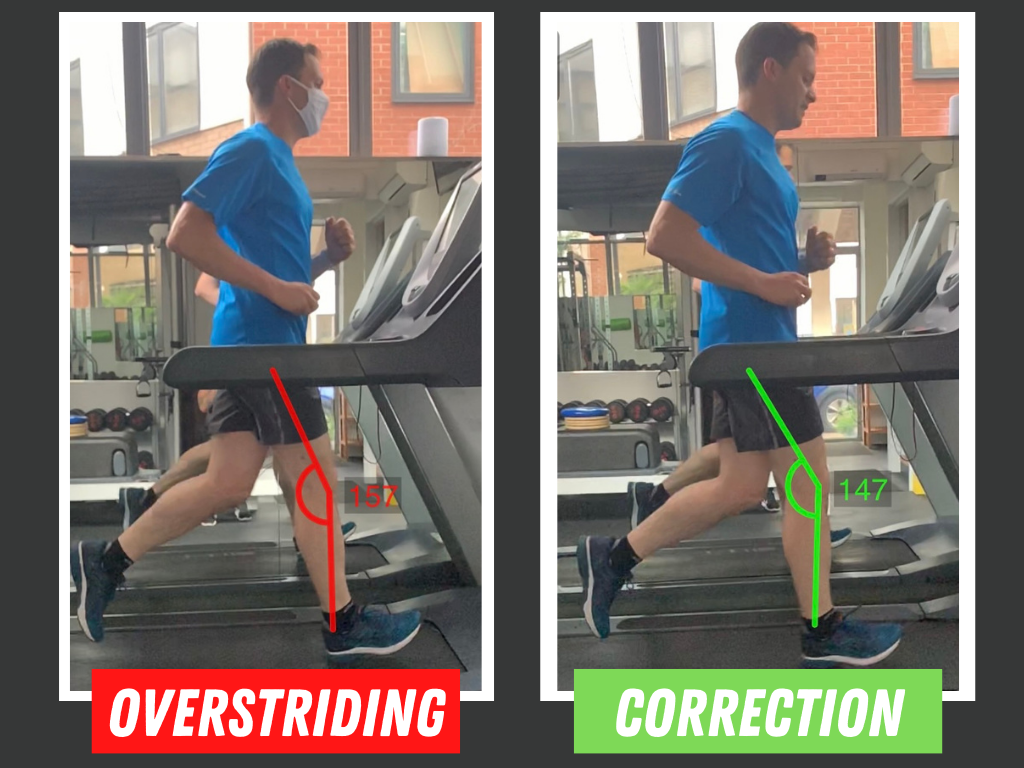
On the left image, there is clear overstriding- this can lead to increase contact time with the ground, which in turn increases the load going through the lower limbs on contact. The right image shows impact being made closer to the body, which in turn reduces forces going through the lower limbs making running more economical and also reducing chances of picking up an injury.
Book an assessment today to see one of our running experts, but in the meantime here some great videos from a few of our experts: