

PEACE & LOVE: The Modern Approach to Managing Back Pain
For decades, the standard advice for soft tissue injuries was RICE: Rest, Ice, Compression, Elevation. It was simple, memorable, and widely used. It was also increasingly at odds with the evidence — and has now been largely superseded by a more sophisticated framework that better reflects how tissue healing actually works.
That framework is PEACE & LOVE. Developed by sports medicine researchers and published in the British Journal of Sports Medicine, it offers a more nuanced, phase-based approach to injury management that optimises recovery rather than simply managing symptoms.
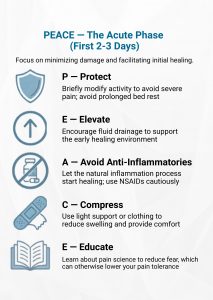
 PEACE — The Early Phase
 PEACE — The Early Phase
In the immediate aftermath of a back pain episode or acute flare, the PEACE principles apply:
P — Protect
Unload the painful area briefly to prevent further aggravation. This does not mean bed rest — it means temporarily modifying activity to avoid movements that provoke severe pain. The emphasis is on brief and temporary.
E — Elevate
Less directly applicable to back pain than to limb injuries, but broadly: reducing swelling and fluid accumulation around irritated tissues supports the early healing environment.
A — Avoid Anti-Inflammatories
This is perhaps the most counterintuitive element of PEACE. Inflammation is not the enemy — it is the first stage of a necessary biological process. Anti-inflammatory medications, particularly NSAIDs, can blunt the inflammatory response and may interfere with long-term tissue healing. Current evidence suggests using them cautiously, if at all, in the early phase of injury.
C — Compress
Gentle compression reduces swelling. For back pain specifically, structured support from clothing or a light brace can provide comfort in the very early stages, but should not become a long-term crutch.
E — Educate
This is the element that distinguishes modern injury management from older approaches. Patient education — about pain science, about what is happening in the tissues, about what to expect — consistently improves outcomes. Fear and uncertainty worsen pain. Understanding reduces it.
LOVE — The Recovery Phase
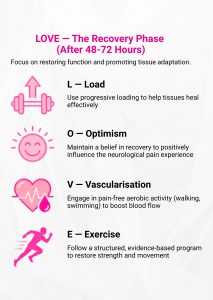 Once the acute phase settles, the LOVE principles guide the return to full function:
L — Load
As we discussed in our previous article on load and capacity, early and progressive loading is central to recovery. Tissues heal more effectively when they are appropriately loaded. Movement is medicine, and this is where the rehabilitation begins in earnest.
O — Optimism
The psychological dimension of recovery is not secondary — it is foundational. Patients who approach recovery with a belief that they will improve consistently do better than those who catastrophise. This is not about positive thinking for its own sake — it reflects the genuine neurological relationship between pain beliefs and pain experience.
V — Vascularisation
Aerobic exercise — walking, cycling, swimming — promotes blood flow to healing tissues and supports recovery. It also has significant benefits for mood, sleep, and stress — all of which influence pain. Cardio is not separate from back pain rehabilitation. It is part of it.
E — Exercise
Structured, progressive exercise is the most evidence-based treatment for back pain at every stage. This means exercises targeted at restoring movement, building strength, and progressively loading the spine and supporting structures. It should be guided by a physiotherapist, particularly in the early stages.
Why This Matters
The shift from RICE to PEACE & LOVE reflects a deeper change in how musculoskeletal medicine understands injury and recovery. Passive, rest-based approaches have consistently underperformed compared to active, education-led, exercise-centred ones. The body heals best when it is given accurate information, appropriate load, and the opportunity to adapt.
At Vitality Physiotherapy, PEACE & LOVE principles underpin how we approach every new back pain presentation — whether you are coming to us acutely, or months into a problem that has not resolved elsewhere.
In our final article in our blog on Back pain, we tackle the question we are asked most often: what is the best exercise for back pain?
Ready to get help with your back pain? Our physiotherapists at Vitality Physiotherapy see patients at our well equipped gyms in Southwark (SE1) and Esher (KT10) clinics. Book a consultation today — we will assess your individual situation and build a plan that actually works for you.
Call us or book online at vitality-physio.co.uk