Golfer’s elbow
Written by George Eaton, MSK Physiotherapist, Vitality Physiotherapy
Aching or sharp pain on the inside of your elbow can make gripping a golf club, carrying a bag, lifting weights or even opening a jar uncomfortable.
Golfer’s elbow is a common cause of this type of pain. Despite the name, you don’t need to play golf to develop it. Repeated gripping, lifting and forearm movements can all place stress on the tissues on the inside of the elbow, so manual workers, gym-goers, gardeners and anyone who grips repetitively can be affected.
The good news is that golfer’s elbow usually responds very well to physiotherapy, strength training and exercise, without the need for surgery. The key is understanding what is irritating the tendon and gradually rebuilding its ability to tolerate load.
What is golfer’s elbow?
Golfer’s elbow, also called medial elbow tendinopathy or medial epicondylalgia, describes pain from the tendons that attach your forearm muscles to the inner side of the elbow.
The area most commonly involved is the common flexor tendon. It attaches several muscles that control the wrist, fingers and forearm to a bony point on the inside of the elbow called the medial epicondyle. These muscles work hard whenever you grip, and when you control the position of your wrist and forearm.
The anatomy
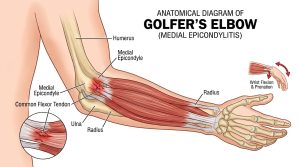 The muscles that bend your wrist and fingers and turn your palm downwards all start from a shared tendon at the medial epicondyle. Because so many muscles share one attachment point, any activity that involves firm or repeated gripping loads this small area heavily.
Symptoms
The symptoms of golfer’s elbow are usually felt around the inside of the elbow, although discomfort can extend down the inner forearm.
You may notice:
A dull ache or sharper pain around the bony point on the inside of the elbow
Pain when gripping firmly
Discomfort when lifting or carrying
Pain when bending the wrist against resistance
Pain when turning the forearm
Reduced grip strength
Stiffness after rest, for example first thing in the morning
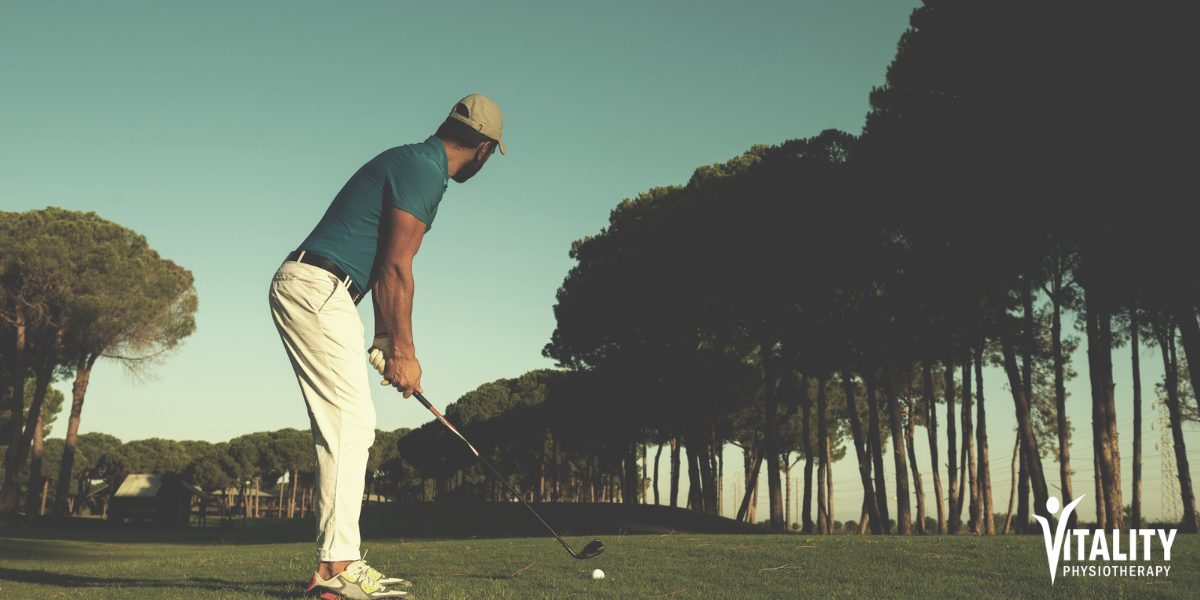
Pain during or after a round of golf
Golfers often notice it most when gripping the club, particularly on harder swings or when playing for longer than usual.
A simple self-check
This movement stretches the muscles involved in golfer’s elbow and can help show whether they are sensitive.
Straighten the affected arm in front of you with your palm facing up.
Using your other hand, gently draw the fingers and wrist back towards you, keeping the elbow straight.
You should feel a stretch along the inner forearm.
If this brings on your familiar pain on the inside of the elbow, the tissues involved in golfer’s elbow may be irritated.
This check can’t confirm golfer’s elbow by itself. Other conditions can cause inner-elbow pain (see below), so persistent symptoms are worth having assessed properly.
How does golfer’s elbow develop?
Golfer’s elbow usually develops when the tendon is repeatedly exposed to more load than it can currently tolerate.
For golfers, this might happen when you:
Return to golf after a long break
Suddenly increase the number of rounds you play
Add frequent driving-range sessions or lots of practice swings
Start hitting harder or further
Change your training programme
Change your equipment or playing habits
Outside golf, similar loading can come from weight training, manual work, gardening, decorating, repetitive tool use or jobs involving frequent gripping and lifting.
It isn’t just about how heavy or intense an activity is. How often you do it, how much you do and how much recovery you allow between sessions all matter.
Golf-specific factors
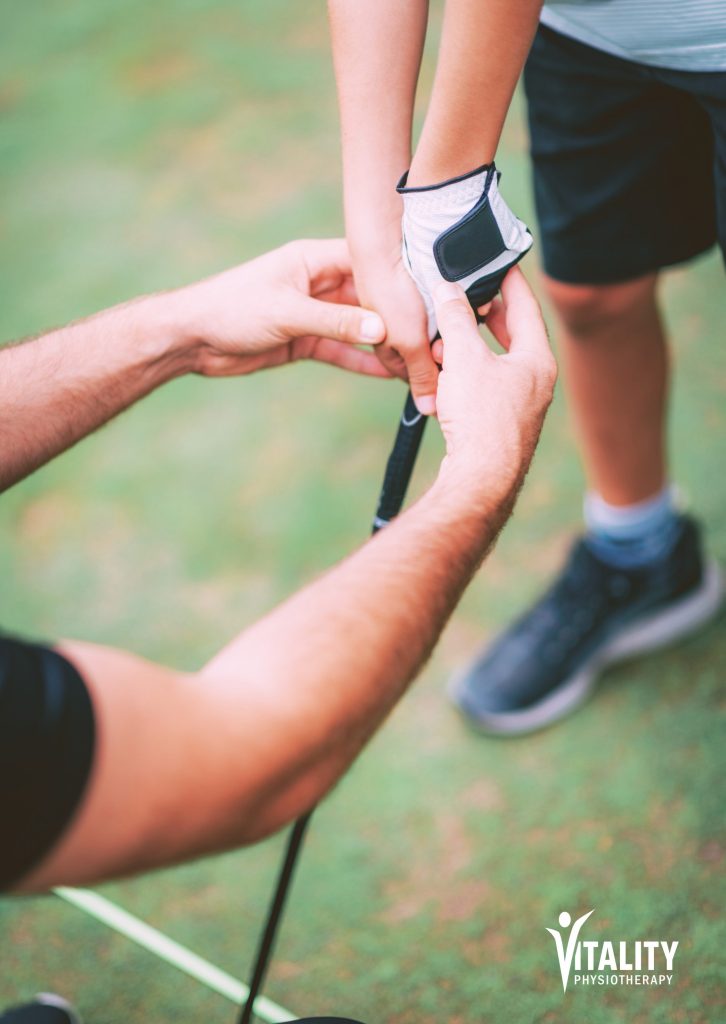
In golfers, golfer’s elbow most often affects the trail arm (the right arm for a right-handed player). Things that can add extra load to the inner elbow include:
Hitting the ground first. Heavy or “fat” shots and deep divots send a jolt up through the club into the forearm.
Driving-range mats. Hard mats don’t give like turf, so a mistimed strike is absorbed by your arm.
Grip pressure. Squeezing the club tightly throughout the swing keeps the forearm muscles working hard.
Grip size and equipment. Grips that are too thin or too thick, or clubs that don’t suit you, can increase the effort needed to control the club.
If any of these sound familiar, a check with your club professional or a club fitting can be a useful part of your recovery alongside physiotherapy.
Assessment
Most cases can be diagnosed with a thorough clinical assessment, without the need for scans. Your physiotherapist will start by discussing your symptoms, how they began and the activities that aggravate them.
Your assessment may include:
Measuring grip strength
Feeling around the medial epicondyle and common flexor tendon for tenderness
Testing wrist bending and forearm turning against resistance
Checking wrist and elbow movement
Functional grip and lifting tests
Assessing your neck, shoulder and the nerves running to the hand
Other causes of inner-elbow pain
Not all pain on the inside of the elbow is golfer’s elbow. Your physiotherapist will also consider:
Ulnar nerve irritation. Tingling, pins and needles or numbness into the ring and little fingers suggests the nerve that runs behind the inner elbow is involved.
Ligament injury. Pain that started with a specific incident, a sense of the elbow giving way, or pain when throwing may point to the ulnar collateral ligament.
Pain referred from the neck. Neck problems can cause pain felt in the elbow and forearm.
If you have significant swelling, can’t fully straighten or bend your elbow, or your symptoms followed a fall or injury, get it assessed promptly rather than waiting to see if it settles.
Treatment
Treatment centres on restoring the elbow’s ability to tolerate load. The exact programme depends on how irritable the tendon is, how strong it currently is and what you need it to do.
Managing load
The first step is usually not to stop everything. Instead, we identify the activities pushing the tendon beyond its current tolerance and adjust them.
For a golfer, that could mean fewer practice swings, playing nine holes instead of eighteen, avoiding the driving range for a while, or easing off on particularly demanding shots.
The aim is to find a level of activity your elbow can manage, then build from there.
Building strength
Once symptoms have settled enough, strengthening becomes the main focus. Exercises target the muscles involved in bending the wrist, gripping and turning the forearm.
Depending on your stage of rehabilitation, this may include:
Isometric (static) holds
Controlled wrist strengthening
Forearm rotation exercises
Grip strengthening
Heavier progressive strengthening as the tendon becomes stronger
This matters because waiting for the pain to disappear doesn’t necessarily restore the strength you need for golf or other demanding activity.
Manual therapy
Manual therapy, such as soft tissue treatment or mobilisation around the elbow, wrist and forearm, may be used alongside exercise to help ease pain and movement. Its purpose is to help you move and load the area more comfortably while the underlying strength is rebuilt.
Other treatments you may hear about
Braces and straps. A forearm strap can ease symptoms during activity for some people. It can be a useful short-term aid but doesn’t replace strengthening.
Steroid injections. Can give short-term pain relief, but the evidence doesn’t support them as a long-term fix, and they are best discussed with your physiotherapist or doctor as part of a wider plan.
Our rehabilitation gym
Our clinics have a private rehabilitation gym designed specifically for patient rehabilitation. It lets us, your Physiotherapists progressively increase resistance and challenge as your elbow improves.
For golfer’s elbow, rehabilitation can progress from early forearm and wrist exercises through to heavier grip strengthening, loaded forearm rotation and golf-specific conditioning.
Common mistakes
One of the most common problems is doing too much too soon. You may feel much better after a period of reduced activity and assume your elbow is ready for a full return to golf. But tendon pain can settle before the tendon has regained its previous strength.
The opposite approach can also cause problems. Avoiding loading completely for a long time can leave the forearm weaker and less prepared for the demands of returning to sport.
Another common mistake is focusing entirely on pain relief without rebuilding strength. Massage, heat, taping and other treatments may make the elbow feel better, but the long-term goal is to restore the capacity you need for gripping, lifting and playing golf.
How long does it take to recover?
Recovery varies from person to person. Many people notice a clear improvement within six to twelve weeks of a structured strengthening programme, but tendons adapt slowly, and symptoms that have been grumbling for months can take longer to fully settle. Returning to full golf is usually a gradual process rather than a single date.
When to seek assessment
Consider a physiotherapy assessment if:
Your inner-elbow pain has lasted for several weeks
Golf is becoming difficult or uncomfortable
Your grip feels weaker
Pain is affecting work, exercise or everyday activities
Symptoms keep returning when you go back to golf
You’ve tried modifying your activity without meaningful improvement
You have tingling or numbness in your ring or little fingers
Frequently asked questions
Can I keep playing golf with golfer’s elbow?
Often, yes, with some changes. Many people can keep playing at a reduced level, such as fewer holes, less range time or easing off on full-power shots, as long as symptoms stay manageable and settle by the next day. Your physiotherapist can help you find the right level.
Should I wear a brace or strap?
A forearm strap can help some people get through activity more comfortably. It’s best used as a short-term aid while you rebuild strength, not as the treatment itself.
What’s the difference between golfer’s elbow and tennis elbow?
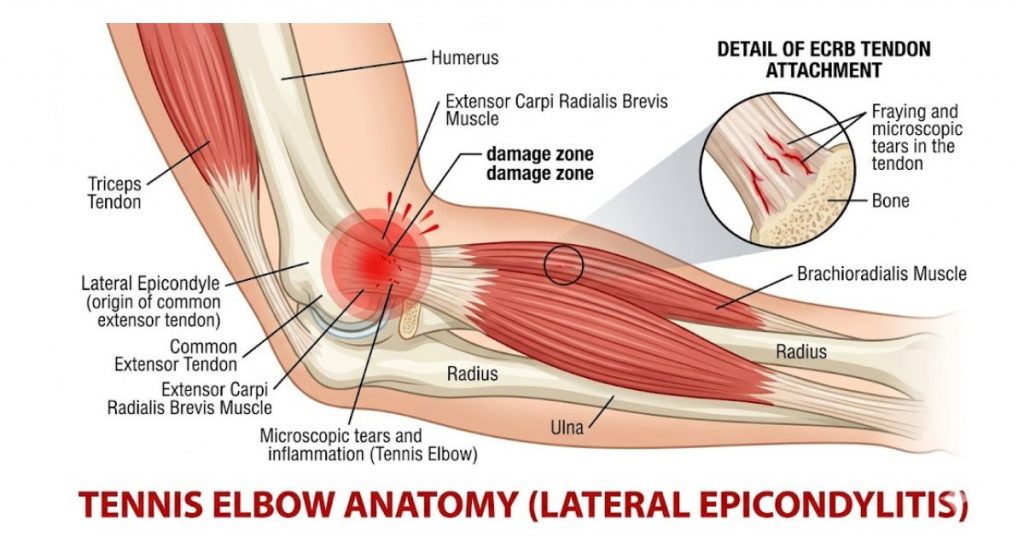
Golfer’s elbow affects the tendons on the inside of the elbow, which bend the wrist and grip. Tennis elbow affects the tendons on the outside, which lift the wrist back. Both are load-related tendon problems and are treated in a similar way, and golfers can develop either.
Do I need a scan?
Usually not. Most cases can be diagnosed with a clinical assessment. A scan may be recommended if your symptoms aren’t improving as expected or another cause is suspected.
If pain on the inside of your elbow is affecting your golf, grip or everyday activities, our physiotherapists can assess the problem and build a rehabilitation plan around what you need to get back to.
We see patients at our Esher (KT10) and Southwark (SE1) clinics, with access to our private rehabilitation gyms for patients who need supervised progressive loading.
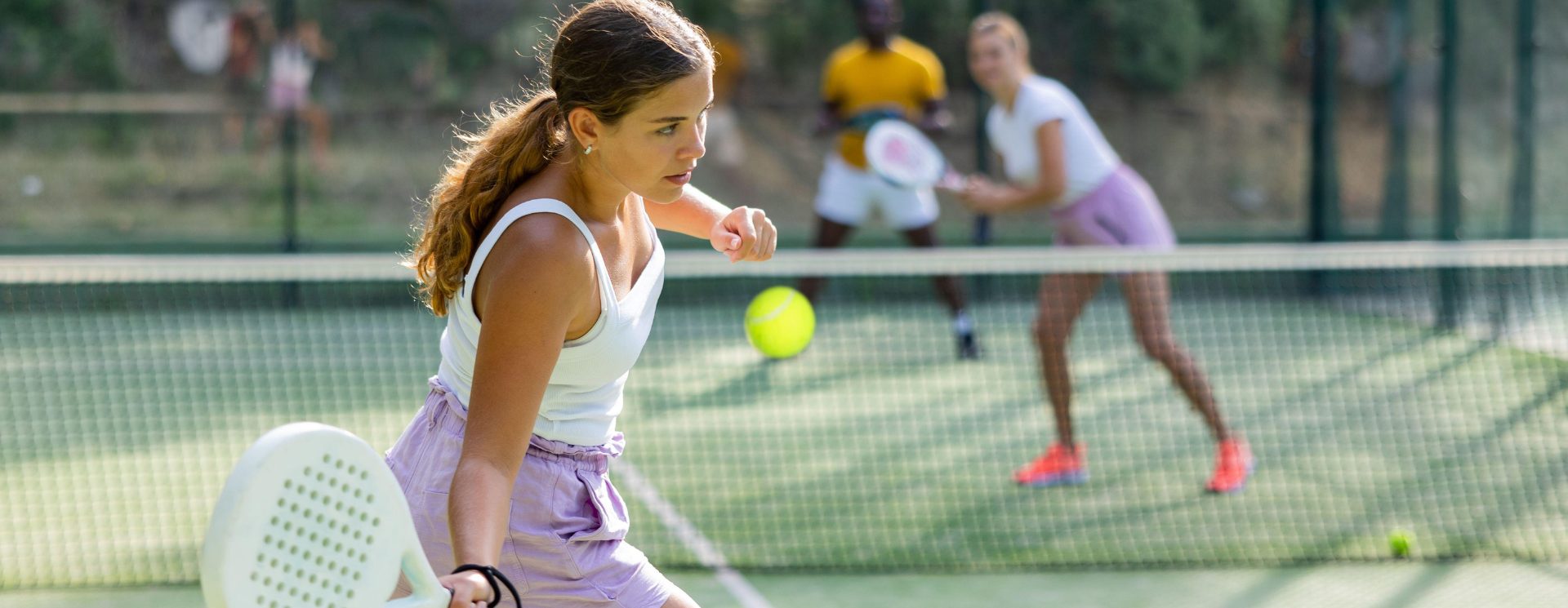
 Tennis elbow — clinically known as lateral elbow tendinopathy — is a condition affecting the tendons that attach the forearm extensor muscles to the outer elbow. The tendon most commonly involved is the extensor carpi radialis brevis (ECRB), which plays a central role in controlling wrist and hand movement.