Why There’s No Single Best Exercise for Back Pain — And What That Means for You


By Janine Enoch, Founder and Clinical Director, Vitality Physiotherapy

If you search online for the best exercises for back pain, you’ll find confident, contradictory advice in abundance. Pilates. Yoga. McKenzie method. Core stability. Dead bugs. Deadlifts. Walking. Swimming. Everyone has a favourite, and most of them claim the evidence is on their side.

Here’s the honest truth from the research: no single exercise type has been shown to be consistently superior for low back pain in the long term. And understanding why that is actually liberates you to focus on what really matters.

What the Studies Show

Pilates vs. Stationary Cycling

A well-designed study compared Pilates to stationary cycling over eight weeks. Both groups improved in pain, disability, and catastrophic thinking. At eight weeks, the Pilates group showed better results. At six months, the difference had disappeared.

This pattern — early advantage for the more ‘specific’ or ‘targeted’ intervention, no long-term difference — appears repeatedly in the back pain literature. It may reflect the power of receiving treatment that feels relevant and purposeful, rather than any specific physiological superiority.

Walking vs. Back-Strengthening Exercises

In another study comparing a simple walking programme to specific back-strengthening exercises, both groups improved similarly. For previously sedentary people, general movement may be as valuable as targeted exercise — because getting moving at all is the intervention.

High Load vs. Low Load

A randomised controlled trial comparing high-load and low-load motor control programmes found better short-term outcomes in the low-load group, but no meaningful difference at 12 or 24 months. Both groups also received pain education, which may have been the most influential component.

What a Systematic Review Found

A comprehensive review of the exercise literature concluded that whole-body programmes — combining strength, resistance, and general movement — had beneficial effects for back pain. Not because of any single mechanism, but because exercise in general is more effective than most passive alternatives.

Why Core Stability Exercises Aren’t the Whole Answer

Core stability has dominated back pain rehabilitation for years, and it isn’t without value. But the evidence has complicated the picture. Studies show that improvements from core exercises are often unrelated to actual changes in abdominal muscle function. The benefit may come from factors like increased confidence, exposure to movement, and the therapeutic relationship — not from ‘switching on’ a specific muscle.

More concerning, an excessive focus on core bracing and spinal stiffness may inadvertently reinforce the very protective guarding that perpetuates pain. People with back pain already tend to show increased muscle co-activation and reduced spinal movement. Training them to brace harder is not always the right answer.

Reduced movement variability — moving in a more rigid, restricted way — is consistently associated with persistent back pain. The goal, for many patients, is actually to feel safer moving freely: to decrease stiffness, not increase it.

So What Should You Do?

The best exercise for back pain is the one you will do consistently, that you find manageable and — ideally — enjoyable. Beyond that:

  • Variety matters: combining different movement types, loads, and intensities tends to produce better long-term outcomes than any single modality
  • Pain education matters: in almost every high-quality study, groups receiving pain education alongside exercise did better than those doing exercise alone
  • Consistency matters more than perfection: a good programme done regularly beats a perfect programme done sporadically
  • Your whole life matters: sleep, stress, nutrition, and relationships all influence how your body responds to exercise and how quickly you recover

The Vitality Physiotherapy Approach
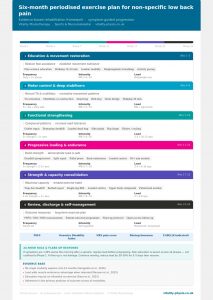
back pain rehabilitation vitality physiotherapyWe don’t have a house exercise for back pain. What we have is a framework: assess the whole person, understand their presentation (how irritable is the pain? what are their goals? what does their daily life look like?), and design a programme that introduces load progressively, builds capacity over time, and adapts as they improve.

We use a macro and microcycling approach to treatment planning — structuring rehabilitation in phases, with clear goals at each stage, and building in the flexibility to adjust based on how an individual is responding. No two programmes look the same. This programme (alongside)is for informational purposes only and does not constitute medical advice. If you are experiencing back pain, please consult a qualified physiotherapist.

Jas’s Story

Ten years ago, I met Jas — a woman in her late 40s  who had just been diagnosed with osteoporosis. Her bone density scans showed a T-score below -2.5, and her fracture risk was classified as high. She was frightened. She loved being active, and the diagnosis felt like a threat to everything she wanted her life to look like.

We started carefully. Weight-bearing and resistance exercises, introduced gradually, progressing as her capacity grew. Regular reassessment. Small adjustments. Alongside her rehabilitation, she made changes to her diet — increasing calcium-rich foods and vitamin D — to support what her body was working hard to do.

There were hard days. But her consistency never wavered.

When Jas returned for her annual review, her scans told a different story. She had moved from osteoporosis into the osteopenia range — a clinically meaningful improvement and a real reduction in fracture risk. Her bones had responded exactly as the evidence predicted: progressively, with appropriate load, given sufficient time.

Jas’s story is one of the highlights of my career. Not because what we did was complicated — it wasn’t. But because it worked precisely because we respected the body’s need for gradual adaptation, built a programme around her as a person, and trusted the process.

That is what good rehabilitation looks like. And it is available to everyone.

Ready to find out what a personalised, evidence-based back rehabilitation programme looks like for you? Get in touch with the team at Vitality Physiotherapy. Clinics in Southwark (SE1) and Esher (KT10).

PEACE & LOVE: The Modern Approach to Managing Back Pain

For decades, the standard advice for soft tissue injuries was RICE: Rest, Ice, Compression, Elevation. It was simple, memorable, and widely used. It was also increasingly at odds with the evidence — and has now been largely superseded by a more sophisticated framework that better reflects how tissue healing actually works.

That framework is PEACE & LOVE. Developed by sports medicine researchers and published in the British Journal of Sports Medicine, it offers a more nuanced, phase-based approach to injury management that optimises recovery rather than simply managing symptoms.

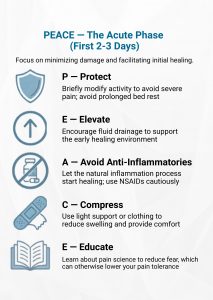
PEACE — The Early Phase

In the immediate aftermath of a back pain episode or acute flare, the PEACE principles apply:

P — Protect

Unload the painful area briefly to prevent further aggravation. This does not mean bed rest — it means temporarily modifying activity to avoid movements that provoke severe pain. The emphasis is on brief and temporary.

E — Elevate

Less directly applicable to back pain than to limb injuries, but broadly: reducing swelling and fluid accumulation around irritated tissues supports the early healing environment.

A — Avoid Anti-Inflammatories

This is perhaps the most counterintuitive element of PEACE. Inflammation is not the enemy — it is the first stage of a necessary biological process. Anti-inflammatory medications, particularly NSAIDs, can blunt the inflammatory response and may interfere with long-term tissue healing. Current evidence suggests using them cautiously, if at all, in the early phase of injury.

C — Compress

Gentle compression reduces swelling. For back pain specifically, structured support from clothing or a light brace can provide comfort in the very early stages, but should not become a long-term crutch.

E — Educate

This is the element that distinguishes modern injury management from older approaches. Patient education — about pain science, about what is happening in the tissues, about what to expect — consistently improves outcomes. Fear and uncertainty worsen pain. Understanding reduces it.

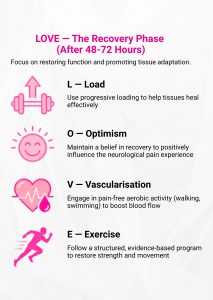
LOVE — The Recovery Phase

Once the acute phase settles, the LOVE principles guide the return to full function:

L — Load

As we discussed in our previous article on load and capacity, early and progressive loading is central to recovery. Tissues heal more effectively when they are appropriately loaded. Movement is medicine, and this is where the rehabilitation begins in earnest.

O — Optimism

The psychological dimension of recovery is not secondary — it is foundational. Patients who approach recovery with a belief that they will improve consistently do better than those who catastrophise. This is not about positive thinking for its own sake — it reflects the genuine neurological relationship between pain beliefs and pain experience.

V — Vascularisation

Aerobic exercise — walking, cycling, swimming — promotes blood flow to healing tissues and supports recovery. It also has significant benefits for mood, sleep, and stress — all of which influence pain. Cardio is not separate from back pain rehabilitation. It is part of it.

E — Exercise

Structured, progressive exercise is the most evidence-based treatment for back pain at every stage. This means exercises targeted at restoring movement, building strength, and progressively loading the spine and supporting structures. It should be guided by a physiotherapist, particularly in the early stages.

Why This Matters

The shift from RICE to PEACE & LOVE reflects a deeper change in how musculoskeletal medicine understands injury and recovery. Passive, rest-based approaches have consistently underperformed compared to active, education-led, exercise-centred ones. The body heals best when it is given accurate information, appropriate load, and the opportunity to adapt.

At Vitality Physiotherapy, PEACE & LOVE principles underpin how we approach every new back pain presentation — whether you are coming to us acutely, or months into a problem that has not resolved elsewhere.

In our final article in our blog on Back pain, we tackle the question we are asked most often: what is the best exercise for back pain?

Ready to get help with your back pain? Our physiotherapists at Vitality Physiotherapy see patients at our well equipped gyms in Southwark (SE1) and Esher (KT10) clinics. Book a consultation today — we will assess your individual situation and build a plan that actually works for you.
Call us or book online at vitality-physio.co.uk

Load, Capacity, and Why Gradual Is Always the Answer

By Janine Enoch, Founder and Clinical Director, Vitality Physiotherapy

Whether you’re a runner, a desk worker, a gym-goer, or someone who simply bent down to pick something up and felt a sharp pain — there is one framework that explains almost every musculoskeletal injury. It’s called load versus capacity, and once you understand it, you’ll never think about back pain — or injury — in quite the same way.

The Basic Principle

Every tissue in your body — muscle, tendon, bone, disc, ligament — has a capacity. That capacity is the amount of load it can absorb without sustaining damage. When the load placed on a tissue exceeds its capacity, injury becomes more likely.

This can happen suddenly, as in a trauma or accident. But the vast majority of back pain we see in clinic doesn’t happen that way. It happens gradually, when someone increases load faster than their tissues can adapt. A new running programme. A return to the gym after a long break. A week of heavy lifting at work. The load wasn’t catastrophic — it just outpaced the body’s ability to keep up.

The Body Is Adaptive — If You Give It Time

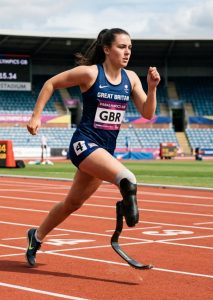
Paralympian performing extraordinary tasks despite assymmetryHere is the part that gets overlooked in most conversations about back pain: capacity is trainable. When load is introduced progressively, tissues respond. Muscles strengthen. Bones become denser. Tendons grow more robust. Discs adapt. The body is not a static, fragile structure — it is a dynamic, responsive system.
Paralympians offer a vivid illustration of this. Athletes competing with significant anatomical asymmetries, limb differences, or structural ‘abnormalities’ perform at extraordinary physical levels. Because their bodies have adapted, gradually and progressively, to the demands placed on them. The body does not require perfection — it requires time.

When Capacity Drops

Capacity isn’t just determined by training history. It fluctuates. And this is why back pain so often seems to come ‘out of nowhere’ — the same movement that was fine last week suddenly causes pain this week.

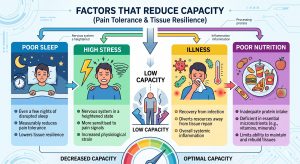
The factors that reduce capacity include:


  • Poor sleep — even a few nights of disrupted sleep measurably reduces pain tolerance and tissue resilience
  • High stress — the nervous system in a heightened stress state is more sensitised to pain signals
  • Illness — recovery from infection diverts resources away from tissue repair
  • Poor nutrition — inadequate protein or micronutrient intake limits the body’s ability to maintain and rebuild tissues

This means that the injury isn’t always about what you did differently. Sometimes you did exactly what you always do — but your capacity had temporarily dipped, and the same load that was previously manageable was now too much.

What About Deadlifts and Rounded Backs?

Few questions come up more often in clinic. There has been enormous fear — among patients and some healthcare professionals — around spinal flexion under load, fuelled by an older theory suggesting that bending the spine while lifting causes dangerous increases in disc pressure.

That theory was based on studies conducted on cadavers. Living tissue behaves very differently. The current evidence does not support the idea that a rounded back during lifting is inherently dangerous. What matters is whether your tissues have been progressively loaded to handle that pattern of movement. The movement itself is not the problem — an unprepared tissue encountering that movement is.

The Practical Takeaway

If you are currently in pain, the immediate goal is to reduce load to a level your tissues can tolerate — not to rest completely, but to find a manageable baseline and rebuild from there.

If you are returning to activity after a period of rest or injury, the principle is the same: gradual, progressive loading. Slower than feels necessary. With attention to how your body responds. Adjusted based on sleep, stress, and how you’re feeling overall — not just on a fixed timeline.

The question to ask yourself is not ‘did I move wrong?’ It’s ‘did I change something too quickly?’ That shift in perspective is often where recovery begins.

At Vitality Physiotherapy, we build progressive, personalised rehabilitation plans that respect your body’s need for adaptation. Whether you’re recovering from injury or trying to prevent the next one, we’re here to help. Clinics in Southwark (SE1) and Esher (KT10).

The Real Reason You’re Still in Pain

Most back pain episodes resolve within a few weeks. The tissue heals, the inflammation settles, and people get on with their lives. But for a significant proportion of people, pain continues long beyond the point where any tissue damage remains — sometimes for months, sometimes for years.

This is not weakness. It is not laziness. And in the vast majority of cases, it is not structural deterioration. There is a well-understood explanation for why pain persists, and understanding it is often the single most important step in recovery.

Pain Is a Protection System, Not a Damage Meter


The most important thing to understand about pain is this: pain is produced by the brain as a protective response, not by damaged tissue. Pain is an alarm — and like all alarms, it can be miscalibrated.

Think of it like a smoke detector. A smoke detector is designed to alert you to fire. But if it is too sensitive, it goes off when you make toast. It is not broken — it is doing its job — but it is responding to a threat level that does not warrant the alarm. Persistent pain works in exactly the same way. The nervous system, having been through an injury, can become sensitised — lowering its threshold and producing pain in response to stimuli that would not normally trigger it.

This is sometimes called central sensitisation. The pain is entirely real. It is just no longer a reliable signal of ongoing tissue damage.


The Role of Fear Avoidance

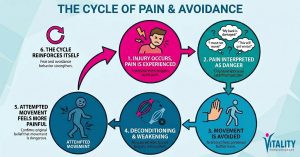
One of the most significant drivers of persistent back pain is a pattern called fear avoidance. It works like this:

  • An injury occurs, and pain is experienced
  • The pain is interpreted as a signal of danger — ‘my back is damaged’, ‘I must not move’, ‘this will get worse’
  • Movement is avoided to protect against further harm
  • Avoidance leads to deconditioning — the muscles weaken, the tissues become less resilient
  • When movement is attempted, it feels more painful — confirming the original belief that it is dangerous
  • The cycle reinforces itself


Flowchart of the Fear-Avoidance Model of chronic pain showing the cycle from initial injury to pain catastrophizing, movement avoidance, and muscle deconditioning


Fear avoidance is not irrational. When you are in pain, protecting the area makes intuitive sense. But it is one of the most reliable predictors of back pain becoming chronic — and it is almost entirely driven by beliefs about what the pain means, rather than by the degree of tissue damage.

Research consistently shows that patients who catastrophise about their pain — who believe the worst about what it means and what will happen — have significantly worse outcomes than those who maintain a more balanced view, even when their initial injury is identical.

What the Evidence Says About Recovery

The good news — and this is very well supported by research — is that fear avoidance is modifiable. The most effective treatments for persistent back pain combine movement with education that specifically addresses pain beliefs.

Cognitive behavioural therapy (CBT) approaches applied to pain have strong evidence behind them. Graded exposure — gradually reintroducing feared movements in a structured, supported way — consistently outperforms passive treatments such as rest, heat, and medication alone.

Recovery rarely happens in a vacuum. Having an evidence- based clinician who explains what is happening, takes your experience seriously, and walks alongside you through movement makes a measurable difference to how well — and how quickly — you recover.

What We Do Differently at Vitality

At Vitality Physiotherapy, pain education is not an add-on to treatment — it is central to it. We spend time at every assessment exploring what our patients believe about their pain, because those beliefs shape behaviour, and behaviour shapes recovery.

We will never tell you that your pain is ‘in your head’. It is not. But we will explain that your nervous system may have become more sensitive than the situation warrants, and that the most evidence-based path forward involves gradually — and safely — rebuilding trust in your body’s ability to move.

In our next article, we look at the load and capacity model: why most back injuries happen not because the spine is fragile, but because load outpaces the body’s current ability to adapt.

Ready to get help with your back pain? Our physiotherapists at Vitality Physiotherapy see patients at our Southwark (SE1) and Esher (KT10) clinics. Book a consultation today — we will assess your individual situation and build a plan that actually works for you.
Call us or book online at vitality-physio.co.uk


Back pain, scans don't tell the full story

Why Your Back Isn’t as Fragile as You’ve Been Told


By Janine Enoch, Founder and Clinical Director, Vitality Physiotherapy

You’ve had a scan. The report mentions disc degeneration, a bulge, or some other finding that sounds alarming. Your GP or a previous clinician may have warned you to be careful, to avoid certain movements, to protect your back. And now you’re frightened — not just of the pain, but of making things worse.

Here’s what we want you to know: your back is almost certainly far stronger and more resilient than you’ve been led to believe. The evidence on this is now very clear, and it changes everything about how we approach low back pain at Vitality Physiotherapy.

What the spine actually looks like

The lumbar spine — the lower back — is made up of five vertebrae connected by facet joints that allow you to flex, extend, bend sideways, and rotate. Between each vertebra sits an intervertebral disc, long cast as the villain in the back pain story.

You’ve probably heard the phrase ‘slipped disc.’ It’s one we don’t use, because it isn’t accurate. Discs don’t slip. They are anchored firmly in place by strong ligamentous attachments. A better way to picture a disc is as a car tyre: thick, fibrous outer walls surrounding a more gel-like centre. Robust. Designed to absorb load and enable movement.

Discs can bulge or sustain injury — but this is far less catastrophic than the language around it implies.

What scans actually show us

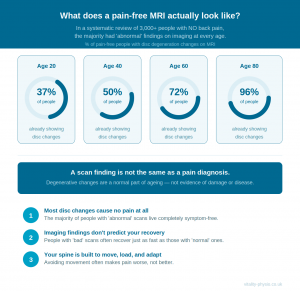
This is where the science gets genuinely surprising. A landmark systematic review examined imaging findings in over 3,000 people who had no back pain whatsoever. Here’s what they found:

  • By age 40, around 50% of pain-free people had disc degeneration visible on MRI
  • By age 50, the majority showed disc bulges — without any symptoms
  • Facet joint changes and other ‘degenerative’ findings were similarly common across all age groups

The conclusion is unavoidable: degenerative changes on imaging are a normal part of ageing, not a diagnosis. A finding on a scan does not tell you why you are in pain, or even whether it is responsible for your pain at all.

Treating a scan result rather than a person is one of the most common mistakes in back pain management — and one we are very careful to avoid.

The posture myth

Few beliefs about back pain are more entrenched — or less well supported — than the idea that posture causes pain. For decades, patients have been told to sit up straight, to avoid slouching, to buy ergonomic chairs, and to never cross their legs.

The research does not back this up. A study of over 1,100 teenagers found no association between sitting posture and pain. In adults, even workers required to maintain awkward positions for sustained periods show no reliable increase in back pain risk. Experts cannot even agree on what constitutes ‘bad’ posture — the concept owes more to military tradition than to biomechanical evidence.

There is no perfect posture. There is no perfect chair. What matters is that you move — regularly, in a variety of ways, and without fear.

So why does back pain happen?

Back pain is real and it can be genuinely debilitating. But the cause is rarely structural fragility. In the next articles in this series, we explore the neuroscience of pain, the crucial relationship between load and capacity, and what the evidence says about treatment and exercise.

The starting point, though, is this: your spine is not broken. It was built to move, to load, and to adapt. And that is exactly what we help you do.

If you have been told your back is damaged and you’re not sure what to do next, our team at Vitality Physiotherapy can offer a thorough assessment and a clear, evidence-based plan. Clinics in Southwark (SE1) and Esher (KT10).

Can AI Replace Your Physio?

Why a Real-Life Physiotherapist Beats an AI Rehab Plan for Back Pain

I recently encountered a post from a runner who shared how they achieved a marathon PB from using ChatGPT. It seemed convenient — quick, accessible, and of course, the running plan was free. When it comes to your back, there’s no substitute for a skilled Physiotherapist who can listen, see, feel, and adapt in real time. That’s the foundation of our learning in orthopaedic medicine.
Having mentored students over many years, I’ve learned that the best Physios listen well, remain curious, and make the complexities of pain less complicated.
Here’s why a real-life Physio beats ChatGPT and all its bot-friends:

Personalised Assessment

AI tools rely on what you type into the search bar, and as we have all discovered, the better the context you give, the better the answer. The problem is that you don’t know what you don’t know.
A Physio asks the important questions, not only the obvious ones, such as what aggravates your pain, but also the less obvious ones- like your lifestyle, nutritional, work, life, and social engagements.
Not only will a good Physio ask great questions, but they will also look critically at how you move. They observe posture, gait, strength, flexibility, breathing, and how your pain changes moment to moment.
Expert human observation is not confined to a singular moment, but is an evolving assessment and reassessment process that matches your needs. This observational cohort study in outpatient Physiotherapy clinics showed that just the history-taking and physical examination performed by physiotherapists produced statistically meaningful improvements in patient pain and function before any “treatment” was applied.

The focus: helping you reach your goals and to get back to doing the things you love. We can spot subtle problems — like pelvic imbalance, poor load transfer, trick movements, and compensations- that no algorithm can detect from text, photos, or even your Garmin data. (No disrespect intended to my favourite data platform.) Furtherore, a skilled practitioner puts you and your goals in the centre and shares in making the important decisions such as when it is best to return to sport.

Correct Diagnosis

Back pain can have many causes, ranging from disc irritation, joint stiffness, muscle spasms, nerve sensitivity, to stress, lifestyle, and even hormonal factors. It’s a nuanced condition. Your pain cannot be oversimplified as a change to your disc or spinal joints. Your back pain also reflects how well your body’s tissues can handle and adapt to the loads placed on them. A great Physio can test, palpate, and clinically reason through these factors. This ensures the plan targets what actually needs fixing.

Real-Time Feedback and Progression

AI gives static exercises, handouts, and guides- a fix-all, monochrome magic formula for everybody. A brilliant Physio provides coaching: correcting form, adjusting load, progressing safely. They lead you to prevent flare-ups and take you beyond what you think is possible. That’s the difference between just doing exercises and doing a targeted goal-oriented, effective, progressive rehab programme.

Holistic Support

Recovery isn’t just physical — it involves sleep, stress, work ergonomics, and movement habits
A real Physio connects all these dots, problem-solves their interconnectedness and helps you stay accountable.

Safety and Trust

If pain worsens or new symptoms appear, an AI can’t respond.
A Physio knows when to modify load (how heavy), mode (how far and what position), rep range and technique. Not only will they provide you with a plan, but they can also adapt it when needed, investigate further, or refer to another medical practitioner when needed.— keeping you safe.
AI can be a great tool for many things; we use it too in our clinics to help write notes and assist with administrative tasks, but it is always Physio-led. For lasting back pain recovery, nothing replaces our expert hands, eyes, clinical reasoning and yes, the trust relationship.
Ready to experience Physio-led care that truly makes a difference? Book your session today and start your path to lasting recovery.

The 5 best exercises for lower back pain in pregnancy

Struggling with back pain in pregnancy? Need to know what exercises to do?

Having a baby can be joyful and daunting at the same time.

The thrills and spills of every trimester bring new challenges and new opportunities to experience the delight of motherhood.

But with all of the joys that come with pregnancy, there can also be a range of pregnancy-related physical changes and symptoms that can be tricky to overcome.

One of the most common complaints is back pain in pregnancy.

This article gives you 5 pilates-based exercises to help you ease your discomfort and feel more mobile so you can get on with your day with less pain.

How pilates exercises help for back pain in pregnancy

Clinical Pilates can help you:

  • Prevent pain
  • Maintain strength
  • Reduce stress
  • Decrease your risk of developing diastasis recti (tummy gap) and pelvic floor problems

Best of all, it’s fun and shown to improve the pregnancy experience in women too!

These low-impact exercises (no bounding or jumping) offer significant benefits, including enhancing your breathing, and helping you build and maintain strength throughout your pregnancy.

This can help prepare your body for carrying your baby and support your recovery after birth, regardless of whether you have a vaginal delivery or caesarean section.

More upsides to Pilates are that you can do it with or without equipment and it’s very versatile. So you can adapt it to your needs and abilities as you progress through your recovery.

At our clinics, we offer clinical pilates sessions tailored to your condition using props when necessary, such at the Pilates ring and Swiss ball.

Although we may use props to enhance the impact of the exercises in clinic, we also show you how to do your exercises at home without any equipment. So you can practice them as regularly as you like.

How to do these pregnancy exercises safely when you have back pain

In the video below you’ll see the top 5 exercises we recommend for pregnant patients experiencing back pain.

Before you do the exercises, it’s important to keep these precautions in mind so you don’t worsen your pain or cause further injury:

  • Ensure you have enough floorspace and room around you for performing the exercises.
  • Listen to your body; don’t push through pain. If something doesn’t feel right, take a break, or skip the exercise.
  • Try not to look at the screen while you’re doing the exercises. It can affect your balance and may hurt your neck. Instead, watch the demonstration then pause it. Do the exercise, then go back and continue to the next one.


Tips for getting these pregnancy back pain exercises right (and why they work)

Exercise 1: Lateral breathing

Lateral breathing will:

  •  Enhance your joint position sense (proprioception)
  •  Increase your lung capacity (how much air your lungs can hold)
  •  Lengthen your spine
  •  Condition your deep abdominal muscles (core)

Exercise 2: Thoracic rotation

Thoracic rotation is key to reducing lower back pain because it helps stabilise and strengthen your lower back muscles, which take on more and more load as your baby grows.

The trick is keeping your waist and hips facing forward, while your ribs and shoulders rotate around your central axis.

Exercise 3: Quadruped hip hinge

A crucial skill to master to prevent lower back pain and control it when it flares, is being able to move your hips without moving your pelvis.

In pregnancy, your pelvic ligaments can become more mobile as a result of hormonal and weight distribution changes. This can cause your pelvis to lose some of its support functions and resulting in lower back pain.

This exercise helps add extra support in your pelvis while moving your hips.

Exercise 4: Quadruped lateral rotation

Similarly to exercise 2, here we focus on opening the chest, whilst keeping the lower back stable.

Notice the difference between stabilising the pelvis here and during exercise 2: Which one did you find easier?

Exercise 5: Semi supine pelvic rotation

This is the most challenging exercise (that’s why it comes last).

As you shift your weight from the left to the right side of your pelvis, focus on maintaining a neutral curve in your back.

Imagine your tailbone always being the heaviest point, with a sense of lightness in the lower back.

Keeping the two sides of your pelvis aligned (without dropping one half during the rotation) helps to strengthen the pelvic ligaments and balances out the pregnancy-related changes mentioned above.

Conclusion

These exercises will help you enjoy your pregnancy more by reducing your back pain. They work by improving your posture and keeping your pelvic floor and deep abdominal muscles strong and functional well.

Things to remember:

  • Make sure to practice these exercises regularly so your muscles remain balanced throughout your pregnancy.
  • Exercises should feel comfortable and no movement should be too difficult – always modify where necessary!
  • If you still experience pain or the exercises aren’t getting easier after a few weeks, you may need a hands-on physiotherapy assessment and individual treatment to get to the root of your problem and heal it.

If you’re experiencing back pain after pregnancy, our Mummy MOT sessions can help you identify the causes.

Need some help getting started or progressing with these exercises?

Prefer to see a specialist physiotherapist in person to assess and treat your pain properly?

Book an appointment with us today and we’ll help you get back on your feet as soon as possible and feeling like yourself again in no time.

Specialist Pilates for pregnancy

In our recent blog, we talked about back pain during pregnancy. Let’s take a look at how a specialist Pilates programme can support the health and good functioning of the pelvic floor in women and men, thus mitigating the risk of developing back pain and reducing it when it occurs.

What is Pilates?

Pilates is a system of training for the body and mind, based on principles created by Joseph Pilates.

By fostering a deep connection between body and mind this incredibly graceful exercise, creates a unique awareness and focus. Pilates practice leads to an intense and deeply satisfying workout, which leaves you feeling stronger, more flexible and at ease in your body.

During a Pilates session at Vitality, you use a range of small props (such as bands, balls, and weights) and equipment, including the Reformer.

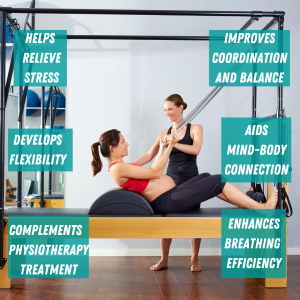
Pilates is the optimal complement to other physical rehabilitation and training programmes, such as physiotherapy, because:

  • It helps re-integrate the injured joint with the rest of the body.

  • It restores and re-trains optimal movement patterns, to prevent the recurrence of issues.

  • It addresses the postural factors that contribute to injury and pain.

The powerful changes that Pilates can bring

How does Pilates help pelvic floor issues?

Pilates exercises can mitigate and improve the following conditions caused by pelvic floor issues:

  • Back pain.

  • Urinary incontinence.

  • Anal and vaginal air.

  • Recovery from vaginal birth and episiotomies.

  • Prolapse.

  • Pelvic floor muscle disorder and pain.

A Pilates-based pelvic floor reconditioning programme focuses on:

  • Training the deep core muscles of the inner unit (transversus abdominis, multifidi, diaphragm). This means conditioning these muscles and learning how to coordinate them.

  • Developing efficient breathing mechanics. Optimal intra-abdominal pressure is needed to ensure the correct functioning of the pelvic floor muscles.

What does this look like in practice?

During a Pilates session at Vitality, our specialist will take you through a series of exercises to condition:

  • The abdominal muscles (lower abdominal fibers and transversus abdominis). For instance, you will perform exercises in a supine position where the spine is neutral and the hips move, e.g. lifting your legs up.

  • The back extensors. For instance, exercises in a prone or standing position where the spine is extended or stabilised against gravity, e.g. moving your limbs when in four-point kneeling.

  • The diaphragm. For instance, breathing exercises to practice coordinating the different muscles in the inner unit, and to practice moving in sync with different breathing patterns, e.g. the classic Pilates exercise ‘Hundred’.


How do I know if I need this?

If you are experiencing lower back pain or any other of the symptoms listed above, book your assessment with us. Our experts will determine the root cause of your issue and develop a personalised programme tailored to your needs and goals.

Top 5 Summer injuries and how to prevent them

1. Gardening injuries

We kicked off June with a very balmy Jubilee weekend and it’s been a brilliant summer so far! If you enjoy a chilled glass of rosé, weekend BBQs, and a spot of gardening too, you’ve found good company!

Gardening injuries, however, are quite common, so here are some handy hints to help you get the most of your long summer days. Extended pruning time, using inappropriate tools, and heavy lifting with poor technique are often the biggest culprits!

Try the following to keep your love for gardening alive:

  • Warm up before you weed-up! Try taking a brisk walk to get your heart rate up, prior to starting your gardening session.
  • Sit on a stool or kneel on foam pads to help prevent knee and back pain when planting or weeding.
  • Long handle tools will reduce the work and prevent you from overstretching.
  • Impose a 20-minute limit (to make a cuppa of course) to take a short break especially if you’re a gardening novice!

Don’t spoil a perfect day in the garden with a pesky injury! If you have any questions about an injury or wondered whether we can help, book a free 15min call to chat about how we could help you.

2. Neck strains

If catching some rays on your back is a priority this summer, be sure to set a timer or get someone to wake you. Apart from the obvious perils of turning into a lobster and the pain associated with it, getting a stiff neck from lying prone (on your tummy) on the beach will certainly put a damper on your holiday. Reading for long periods on a sun lounger can also cause a crick in the neck, so be sure to do a few neck stretches every so often to keep your neck mobile. Here are some useful neck stretches to try. 

  • Tilt your head to one side and hold for 15-20 sec and then to the other side. 
  • Roll your shoulders forwards 5 times and then backward. 


3. Running shin splits 

Trying to get beach-fit quickly? Trying to run away those extra pounds? A sudden increase in running thresholds (especially if you’ve never run) is one of the biggest single causes of shin splints. This, together with wearing inappropriate footwear, a higher BMI and flat feet are among the top factors that can result in shin splints. Try switching to swimming or cycling instead and seek physiotherapy advice before hitting the pavement again to avoid this common summer injury.  


4. Plantar fasciitis

In warmer weather, we tend you to swap our more supportive shoes for flip-flops, pumps, and sandals. Whilst increasing the airflow helps us feel cooler, our feet have to work a lot harder to help us move. This can cause aching burning feet at the end of the day. The intrinsic foot muscles may have deconditioned over the long winter and therefore be subject to strain and fatigue. If you suffer from burning feet, try doing the following: 

Place a bottle of water in the freezer for an hour or so. Place it under your foot to act as an ice roller- trust me, it will absolutely hit the spot to relieve your burning feet! 


5. Cycling injuries 

Fair weather cyclists the world over can all relate to a “dead pinky” or lower back pain after getting into the saddle. Bike setup is crucial to your cycling comfort and can also contribute to the work of cycling. Your pre-bike fitness however will set you up to ensure you’re recruiting the correct muscles for your pedal power and avoid injury. Weak glutes are sometimes responsible for overworking the lumbar spine or hamstrings. A simple bridge exercise is useful for hip mobility and strength, particularly for cyclists as it replicates the action of the downward force of pedaling and isolates glut muscles.  


We hope that these few simple golden nuggets will help keep those summer injuries at bay and that you have a wonderful and long summer! 

5 injuries you didn’t think you could get from cycling

1. Runner’s knee

Yes, I said it! You can get runner’s knee from cycling. Contrary to popular belief, this painful problem is not confined to those who hit the pavements in their trainers alone. In fact, there’s a growing number of cyclists that land up on my treatment table that have been plagued with this pesky problem. The problem with cycling (cue “gasp” from our lycra-clad friends) is that the answer may not always be straight forward.

Read More