

Load, Capacity, and Why Gradual Is Always the Answer
By Janine Enoch, Founder and Clinical Director, Vitality Physiotherapy
Whether you’re a runner, a desk worker, a gym-goer, or someone who simply bent down to pick something up and felt a sharp pain — there is one framework that explains almost every musculoskeletal injury. It’s called load versus capacity, and once you understand it, you’ll never think about back pain — or injury — in quite the same way.
The Basic Principle
Every tissue in your body — muscle, tendon, bone, disc, ligament — has a capacity. That capacity is the amount of load it can absorb without sustaining damage. When the load placed on a tissue exceeds its capacity, injury becomes more likely.
This can happen suddenly, as in a trauma or accident. But the vast majority of back pain we see in clinic doesn’t happen that way. It happens gradually, when someone increases load faster than their tissues can adapt. A new running programme. A return to the gym after a long break. A week of heavy lifting at work. The load wasn’t catastrophic — it just outpaced the body’s ability to keep up.
The Body Is Adaptive — If You Give It Time
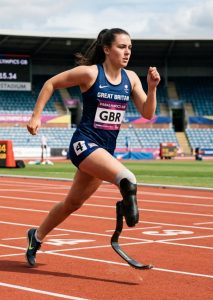 Here is the part that gets overlooked in most conversations about back pain: capacity is trainable. When load is introduced progressively, tissues respond. Muscles strengthen. Bones become denser. Tendons grow more robust. Discs adapt. The body is not a static, fragile structure — it is a dynamic, responsive system.
Paralympians offer a vivid illustration of this. Athletes competing with significant anatomical asymmetries, limb differences, or structural ‘abnormalities’ perform at extraordinary physical levels. Because their bodies have adapted, gradually and progressively, to the demands placed on them. The body does not require perfection — it requires time.
When Capacity Drops
Capacity isn’t just determined by training history. It fluctuates. And this is why back pain so often seems to come ‘out of nowhere’ — the same movement that was fine last week suddenly causes pain this week.
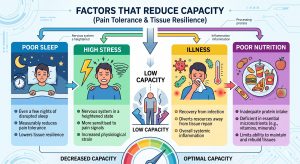 The factors that reduce capacity include:
- Poor sleep — even a few nights of disrupted sleep measurably reduces pain tolerance and tissue resilience
- High stress — the nervous system in a heightened stress state is more sensitised to pain signals
- Illness — recovery from infection diverts resources away from tissue repair
- Poor nutrition — inadequate protein or micronutrient intake limits the body’s ability to maintain and rebuild tissues
This means that the injury isn’t always about what you did differently. Sometimes you did exactly what you always do — but your capacity had temporarily dipped, and the same load that was previously manageable was now too much.
What About Deadlifts and Rounded Backs?
Few questions come up more often in clinic. There has been enormous fear — among patients and some healthcare professionals — around spinal flexion under load, fuelled by an older theory suggesting that bending the spine while lifting causes dangerous increases in disc pressure.
That theory was based on studies conducted on cadavers. Living tissue behaves very differently. The current evidence does not support the idea that a rounded back during lifting is inherently dangerous. What matters is whether your tissues have been progressively loaded to handle that pattern of movement. The movement itself is not the problem — an unprepared tissue encountering that movement is.
The Practical Takeaway
If you are currently in pain, the immediate goal is to reduce load to a level your tissues can tolerate — not to rest completely, but to find a manageable baseline and rebuild from there.
If you are returning to activity after a period of rest or injury, the principle is the same: gradual, progressive loading. Slower than feels necessary. With attention to how your body responds. Adjusted based on sleep, stress, and how you’re feeling overall — not just on a fixed timeline.
The question to ask yourself is not ‘did I move wrong?’ It’s ‘did I change something too quickly?’ That shift in perspective is often where recovery begins.
At Vitality Physiotherapy, we build progressive, personalised rehabilitation plans that respect your body’s need for adaptation. Whether you’re recovering from injury or trying to prevent the next one, we’re here to help. Clinics in Southwark (SE1) and Esher (KT10).