
Most of the women I see in clinic have spent years doing the “right” things — attending yoga or Pilates classes, walking regularly, perhaps running. And yet many arrive in their mid-forties feeling physically less capable than they expected. Joints ache. Energy is lower. The body feels less responsive. Often, the missing piece is the same: they have never been told to lift heavy things.
The conversation around strength training for women has shifted significantly in recent years, but the clinical message hasn’t fully reached the people who need it most. This article explains why progressive resistance training matters so much for women specifically in midlife, what the evidence says, and what that means practically.
“Oestrogen does far more than manage reproduction. Its decline at perimenopause sets off a cascade across bone, muscle, metabolism, and the brain — all of which progressive strength training directly counters.”
What changes at perimenopause
Perimenopause typically begins in the mid-to-late forties, though for some women it starts earlier. The hallmark is fluctuating and declining oestrogen — but the systemic effects of that decline are far wider than most women realise.
Oestrogen is involved in muscle protein synthesis, bone remodelling, glucose metabolism, collagen turnover, and neurotransmitter regulation. When levels drop, these systems are all affected simultaneously. The result is not simply hot flushes and irregular periods; it is a body-wide shift in how tissue is built, maintained, and used.
Progressive strength training acts on every one of these systems. That is why it sits at the centre of evidence-based perimenopause management — not as a nice-to-have addition, but as the primary active intervention.
Five reasons the evidence is compelling
1.Muscle and metabolism
Sarcopenia — age-related muscle loss — begins in our thirties and accelerates sharply at menopause. Women lose between 3 and 8 per cent of muscle mass per decade, and this rate increases when oestrogen declines. Muscle is not simply the tissue that moves us; it is the largest site of glucose disposal in the body and the primary driver of resting metabolic rate.
As muscle mass falls, insulin sensitivity decreases. Visceral fat — the metabolically active fat surrounding the organs — accumulates. Risk of type 2 diabetes and cardiovascular disease rises. This is not an inevitable consequence of ageing. It is, in large part, a consequence of insufficient mechanical loading of the musculoskeletal system.
Progressive resistance training stimulates muscle protein synthesis through the mTORC1 signalling pathway, and upregulates GLUT4 transporter expression — improving insulin sensitivity independently of weight change. Aerobic exercise alone does not achieve this.
2.Bone density
Oestrogen directly inhibits osteoclast activity — the cellular process responsible for breaking down bone. When oestrogen falls, osteoclasts become relatively more active, and bone density decreases. In the five years following menopause, women can lose up to ten per cent of their bone mineral density.
The consequences are serious. Hip fracture in older women carries a one-year mortality risk of 20–30 per cent. Vertebral fractures cause chronic pain and loss of height. Many of these fractures happen not in the elderly, but in women in their sixties and early seventies — the direct result of bone density losses that began at perimenopause.
Mechanical loading — particularly weight-bearing and resistance exercise — is the primary non-pharmacological stimulus for osteoblast activity and bone remodelling. Bone responds to the forces placed upon it. Remove those forces, and it resorbs. Apply them progressively, and bone density is preserved and in many cases improved.
3.Pelvic floor
This is rarely discussed in mainstream strength training conversations, but it is directly relevant to women’s health physiotherapy. The pelvic floor is skeletal muscle — it responds to exactly the same training principles as any other muscle group. Oestrogen loss reduces collagen quality and tissue elasticity throughout the pelvic floor and supporting ligaments, increasing risk of stress urinary incontinence, urgency, and pelvic organ prolapse.
Integrated strength training — loading the glutes, hips, and trunk through full range of movement — supports pelvic floor function by improving the mechanical environment in which the pelvic floor operates. This is why strength training and pelvic floor rehabilitation are not separate concerns; they are part of the same clinical picture.
A note of caution: high-impact exercise without adequate pelvic floor preparation can worsen symptoms in women who already have dysfunction. Assessment before programme design matters.
4.Brain and mood
Resistance training increases BDNF (brain-derived neurotrophic factor), which supports hippocampal neurogenesis — the same region of the brain affected by oestrogen withdrawal and responsible for the cognitive symptoms many women describe in perimenopause: brain fog, word-finding difficulties, low mood, and anxiety.
Multiple randomised controlled trials show that progressive resistance training outperforms aerobic exercise for executive function in women over 55. There is also strong evidence for its effect on depression and anxiety — comparable in several meta-analyses to antidepressant medication for mild-to-moderate presentations.
5.Longevity and independence
The most compelling long-term argument is this: grip strength and lower limb power are the strongest physical predictors of all-cause mortality and hospitalisation in older adults — stronger than cardiovascular fitness alone. The body’s ability to produce force against resistance is, quite literally, a measure of how robustly it is ageing.
The window between forty and sixty is particularly high-leverage. The capacity to build muscle and bone is not lost in midlife — but it does become harder to build in later decades. Investments made now compound over the following thirty years. Muscle and bone built in the fifties is the reserve the body draws on in the eighties.
What this looks like practically
The question I am most often asked is: how much is enough? The evidence is reasonably consistent on the minimum effective dose:
Evidence-based prescription
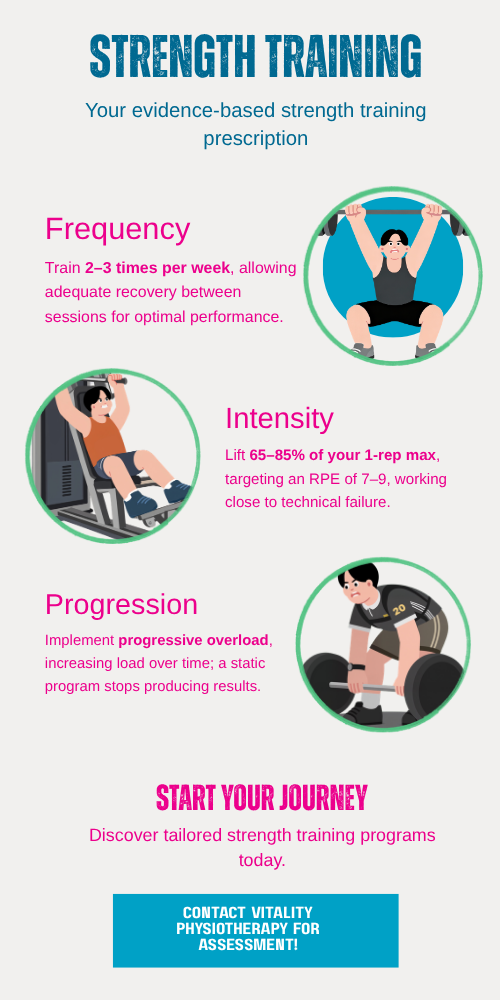
The word “progressive” is doing important work here. Walking to the gym and completing the same exercises at the same weight every week is better than nothing, but it will not drive the bone and muscle adaptations described above. The stimulus must be sufficient to challenge the tissue — and it must increase over time as the tissue adapts.
This is where professional guidance matters. Women who have not trained with load before often underestimate how much they can lift safely with good technique, and often overestimate how much they need to do. More is not always better; well-designed, progressive, and adequately recovered is better.
Common objections — addressed
- “I’ll get bulky”
Women have approximately one-tenth the testosterone of men and significantly lower anabolic hormone levels overall. Building large muscle mass requires a specific and sustained hormonal and nutritional environment that most women do not have. What progressive training produces is strength, density, and functional capacity — not size.
- “I have joint pain — won’t it make things worse?”
In most cases, the opposite is true. Muscle is the primary shock absorber and stabiliser of every joint in the body. Strengthening the muscles around an arthritic knee, for example, directly reduces joint load and pain. The evidence for strength training in osteoarthritis is among the strongest in musculoskeletal physiotherapy.
- “I already do Pilates / yoga / walking”
These are valuable activities — for mobility, stress management, and general movement health. They do not, however, produce sufficient mechanical loading to drive the bone density and muscle protein synthesis changes described here. They are excellent complements to resistance training, not substitutes for it.
- “Isn’t it too late to start?”
No. Studies show meaningful improvements in muscle mass, bone density, and metabolic markers in women in their sixties, seventies, and eighties who begin resistance training. Earlier is better, but there is no age at which it stops being beneficial.
A note on pelvic floor and starting safely
For women with any history of pelvic floor dysfunction — leaking with exercise, urgency, or symptoms of prolapse — a pelvic floor assessment before beginning a loading programme is advisable. Heavy lifting with an unprepared pelvic floor can worsen symptoms. This is not a reason to avoid strength training; it is a reason to begin with appropriate clinical guidance.
At Vitality Physiotherapy, we frequently work with women who want to begin strength training but have concerns about pelvic floor symptoms. The two things — rehabilitation and loading — are not in opposition. With proper assessment and programming, most women can progress to the loading volumes that produce meaningful physiological benefit.
Ready to start — or not sure where to begin?
Our women’s health physiotherapists work with women at all stages of perimenopause and beyond. Whether you’re managing symptoms, starting a strength programme for the first time, or returning to training after injury, we can help you build a programme grounded in evidence.