

The Real Reason You’re Still in Pain
Most back pain episodes resolve within a few weeks. The tissue heals, the inflammation settles, and people get on with their lives. But for a significant proportion of people, pain continues long beyond the point where any tissue damage remains — sometimes for months, sometimes for years.
This is not weakness. It is not laziness. And in the vast majority of cases, it is not structural deterioration. There is a well-understood explanation for why pain persists, and understanding it is often the single most important step in recovery.
Pain Is a Protection System, Not a Damage Meter

The most important thing to understand about pain is this: pain is produced by the brain as a protective response, not by damaged tissue. Pain is an alarm — and like all alarms, it can be miscalibrated.
Think of it like a smoke detector. A smoke detector is designed to alert you to fire. But if it is too sensitive, it goes off when you make toast. It is not broken — it is doing its job — but it is responding to a threat level that does not warrant the alarm. Persistent pain works in exactly the same way. The nervous system, having been through an injury, can become sensitised — lowering its threshold and producing pain in response to stimuli that would not normally trigger it.
This is sometimes called central sensitisation. The pain is entirely real. It is just no longer a reliable signal of ongoing tissue damage.
The Role of Fear Avoidance
One of the most significant drivers of persistent back pain is a pattern called fear avoidance. It works like this:
- An injury occurs, and pain is experienced
- The pain is interpreted as a signal of danger — ‘my back is damaged’, ‘I must not move’, ‘this will get worse’
- Movement is avoided to protect against further harm
- Avoidance leads to deconditioning — the muscles weaken, the tissues become less resilient
- When movement is attempted, it feels more painful — confirming the original belief that it is dangerous
- The cycle reinforces itself
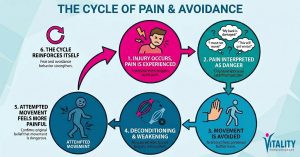
Fear avoidance is not irrational. When you are in pain, protecting the area makes intuitive sense. But it is one of the most reliable predictors of back pain becoming chronic — and it is almost entirely driven by beliefs about what the pain means, rather than by the degree of tissue damage.
Research consistently shows that patients who catastrophise about their pain — who believe the worst about what it means and what will happen — have significantly worse outcomes than those who maintain a more balanced view, even when their initial injury is identical.
What the Evidence Says About Recovery
The good news — and this is very well supported by research — is that fear avoidance is modifiable. The most effective treatments for persistent back pain combine movement with education that specifically addresses pain beliefs.
Cognitive behavioural therapy (CBT) approaches applied to pain have strong evidence behind them. Graded exposure — gradually reintroducing feared movements in a structured, supported way — consistently outperforms passive treatments such as rest, heat, and medication alone.
Recovery rarely happens in a vacuum. Having an evidence- based clinician who explains what is happening, takes your experience seriously, and walks alongside you through movement makes a measurable difference to how well — and how quickly — you recover.
What We Do Differently at Vitality
At Vitality Physiotherapy, pain education is not an add-on to treatment — it is central to it. We spend time at every assessment exploring what our patients believe about their pain, because those beliefs shape behaviour, and behaviour shapes recovery.
We will never tell you that your pain is ‘in your head’. It is not. But we will explain that your nervous system may have become more sensitive than the situation warrants, and that the most evidence-based path forward involves gradually — and safely — rebuilding trust in your body’s ability to move.
In our next article, we look at the load and capacity model: why most back injuries happen not because the spine is fragile, but because load outpaces the body’s current ability to adapt.
Ready to get help with your back pain? Our physiotherapists at Vitality Physiotherapy see patients at our Southwark (SE1) and Esher (KT10) clinics. Book a consultation today — we will assess your individual situation and build a plan that actually works for you.
Call us or book online at vitality-physio.co.uk